Environmental
Conservation of a natural world

Cutting air pollution in the office and in the outside world
Air pollution affects both the external environment and the internal working environment. We're committed to avoiding and reducing greenhouse gas emissions to help improve air quality, reduce pollution and create more sustainable workplaces.
We aim to cut pollution and reduce particle emissions as far as possible during:
- Printing device operation, by installing filter devices to reduce particle emissions
- Transportation, by favouring logistics and transport that have a lower environmental impact
We're striving to reduce particle emissions
Indoor air quality (IAQ) is an important factor linked to better health and wellbeing. There's growing awareness of:
- The environmental risks arising from chemicals, such as volatile organic compounds (VOCs) emitted by construction materials, cleaning products and office equipment
- The health impacts of fine particulates, which can present challenges to people with allergies or other health conditions that increase sensitivity to dust and particulates
As part of our commitment to improving our customers’ individual work environments, Konica Minolta has developed effective solutions to help our customers optimise IAQ and create a workplace that's better for everyone's health, comfort and productivity.
Although laser printers may be only one of many sources of odours and emissions in the office environment, we aim to minimise their impact. We've developed dedicated, high-performance filter devices (or air cleaning units) for our office systems that simultaneously:
- Ensure high particle emission reduction
- Optimise airflow so that devices work efficiently and reliably
Our air cleaning units last the device lifetime and never need replacing. There are three options:
- Standard air cleaning unit, fitted as standard to the latest Konica Minolta devices, reducing emissions by at least 90%
- Optional air cleaning unit, attached to the outside of an office device, reducing emissions by 82%–97%
- External filter devices (if an air cleaning unit can't be attached to a device), reducing emissions by up to 98%
Find out more about Indoor air quality and our air cleaning units.
Environmental initiatives at Konica Minolta
As part of our broader ESG commitments, Konica Minolta is committed to contributing positively to its own environmental impact and that of its customers and partners. Our activities on climate change, the circular economy, and cutting pollution are integral to our commitment and include the following.
Indoor Air Quality
The air we breathe is closely linked to our health and wellbeing – and the air at our place of work is likely to affect our comfort and productivity. Konica Minolta is committed to improving people’s working environments in whichever way possible, for instance by offering sustainable and effective solutions that help our customers improve the Indoor Air Quality (IAQ) of their working space by reducing emissions.
Konica Minolta’s products are certified with proven labels & standards

Blue Angel
The Blue Angel mark was established in 1978. It is now one of the best-known ecological labels. Konica Minolta systems were the first laser-based copier systems worldwide to be awarded in 1992. Nearly all of the current office devices sold in Germany carry this label. All devices comply with the requirements of the strict German label even those sold outside Germany.

De-inking
The removal of ink or toner from paper is crucial for the production of recycled paper. This is guaranteed with Konica Minolta’s toners (e.g.Simitri® HD & Simitri® V), which achieved top results in the INGEDE deinking test.
ECO LEAF
ECO LEAF is a Japanese label that provides information on the environmental impact of a product, based on quantitative measurement of the environmental performance through the product’s entire lifecycle, from raw materials procurement to production, sales, usage, disposal and recycling. Konica Minolta provides environmental impact data relating to most of its equipment through the ECO LEAF.

Fogra
The Fogra VPS (Validation Printing System) certification is aimed at digital printing system providers and serves as proof of the conformity of their product with the criteria of ISO 12647-8. The print production devices are checked for various printing conditions covering a wide range of capabilities. These included PDF/X conformance, proofing substrate colour, gloss and fluorescence, colour accuracy, uniformity, permanence, and light fastness. Other factors were fading, long and short-term repeatability, print rub resistance, colorimetric tone value transfer, tone value reproduction limits, image register and resolving power and margin information. Print Providers benefit from a proven and certified production devices with the guarantee of highest print quality and reliability.

Document authenticity by PTS
There is an Ordinance for Lawyers and Notaries in Germany (DONot), § 29 that gives the framework for making manipulation to printouts impossible. Documents should be very fine and detailed; also, every attempt to change the content of prints must be visible. The majority of our devices is able to fulfil these criteria.
Emissions transparency for the printer fleet
Konica Minolta offers transparency on usage phase about printer emissions:
Our bizWORKPLACE total cost of ownership (TCO) assessment tool provides an environmental audit of the printer fleet. It determines the energy consumption of printers and the consumption of consumables, such as paper and ink/toner. Furthermore, it provides periodic environmental reporting to ensure optimised performance over time.
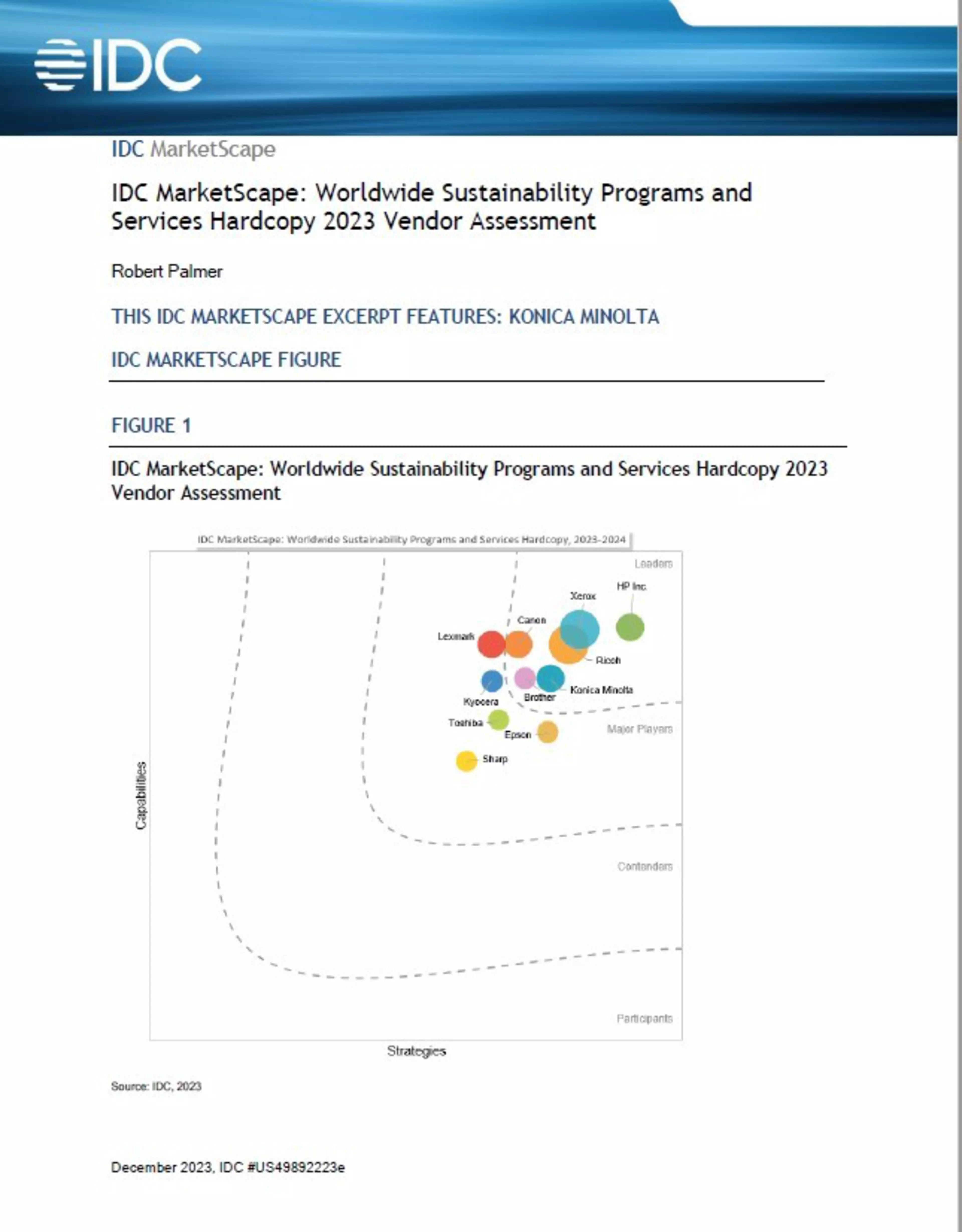
IDC MarketScape: Worldwide Sustainability Programs and Services Hardcopy 2023 Vendor Assessment
Konica Minolta has been named a ‘Leader’ in the IDC MarketScape: Worldwide Sustainability Programs and Services Hardcopy 2023 Vendor Assessment (doc #US49892223, December 2023). The IDC MarketScape states that, “Organizations should consider Konica Minolta when looking for a supplier that is taking decisive actions to reduce climate impact, while promoting the effective use of resources for customers and within its own supply chain.”